
3 Overlooked Benefits of a Documented Waterproofing Repair
The less obvious benefits of a well-planned waterproofing repair appear after the drip stops: you can reinstate the room with greater confidence, coordinate future work and retain a useful record of what was repaired. Those benefits depend on identifying the source and checking the result. A fresh coating alone does not establish either.
This guide is for private-home owners deciding what a successful repair should leave behind. For the basic role of waterproofing in the building, see why waterproofing matters.
1. You can plan reinstatement around evidence
A ceiling stain creates two jobs: address the moisture source and restore the damaged finish. They are connected, but they are not interchangeable. Repainting may improve the appearance while leaving you unable to tell whether the underlying problem has changed.
A properly scoped repair gives you a sequence to work with. First establish the likely source and any remaining uncertainty. Then complete the agreed repair and verification. Finally, assess whether the affected materials are ready for drying, replacement or decorating. Different materials and conditions require different decisions; there is no universal number of days after which every ceiling can be closed or painted.
Consider a hypothetical bedroom with staining beside a built-in wardrobe. A proposal that includes only external sealing leaves several questions open: who checks behind the cabinet, who protects its contents and who decides whether the backing can remain? Resolving those items early is more useful than discovering them after the access team leaves.
The benefit is a clearer basis for reinstatement, not a guarantee that every affected finish can be saved. Keep photographs before decoration and agree what to do if the mark returns. Our water-damage guide explains the observations worth recording.
2. The repair becomes easier to coordinate with other work
Waterproofing often sits beside another project: repainting, changing windows, fitting rooftop equipment or renovating a bathroom. When each contractor works from a separate assumption, one completed detail can become the next trade's obstacle.
A documented repair scope identifies the surfaces and junctions that must remain intact. It also gives the other trades something concrete to check before drilling, fixing supports or changing finishes. Ask for the treated locations, photographs of concealed details and any restrictions on subsequent work.
For a condominium, the coordination may involve the managing agent, an adjoining owner and access through another unit. Agree the investigation arrangements and communication route early. That agreement does not decide final liability, but it makes the practical work easier to organise.
For a landed home, explain planned roof equipment or façade alterations before accepting a waterproofing proposal. It may be sensible to coordinate the programmes, but the contractor needs to assess the actual design and sequence. Avoid assuming that a newly completed membrane can simply be penetrated and resealed without review.
Ask: “Which later activities could affect this repair, and who should we consult before carrying them out?” Put the answer in the handover record rather than relying on a conversation remembered differently by each person.
3. Future maintenance starts from a known position
Without records, the next leak investigation may begin with little more than “someone waterproofed this area a few years ago”. A useful handover makes the treatment understandable to an owner, managing agent or future contractor.
Keep a short repair file containing:
- The original symptom and investigation findings.
- The locations treated and any areas excluded.
- The product or system used, with relevant maintenance instructions.
- Before, during and completion photographs.
- Verification results and the conditions under which checks were made.
- The written warranty, exclusions and contact for reporting recurrence.
These records help distinguish a return of the original problem from a new defect elsewhere. They also make quotation comparisons more specific. An owner can ask about a particular joint or membrane instead of requesting another undefined “full waterproofing” package.
A maintenance record is not proof of a financial return. It may reduce uncertainty and repeated investigation, but a savings percentage would need evidence from a defined comparison. The same caution applies to claims about property value.
Benefits that should be treated separately
Waterproofing is not automatically insulation, ventilation improvement or mould remediation. The US EPA's moisture guidance distinguishes water entry from humidity and condensation. Its general explanation is useful here, but it is not a Singapore building regulation.
If dampness continues after a repair, investigate the remaining moisture sources rather than assuming the solution is another coating. Any affected materials may also need separate attention. Do not accept a promise that one waterproofing treatment will improve health or reduce air-conditioning bills without a specific, evidenced basis.
Ask for an outcome you can recognise
A good question before commissioning work is: “What will I receive that shows what changed, what was checked and what I need to maintain?” That shifts the discussion from an attractive finish to a usable repair record.
Hydroseal can assess water-ingress concerns in private condos and landed homes. Arrange a free site inspection and ask for the proposed repair, reinstatement responsibilities and applicable warranty terms in writing.
Unsure about your property’s waterproofing?
Hydroseal offers a free, no-obligation site inspection, honest advice, no pressure.
Get a free quote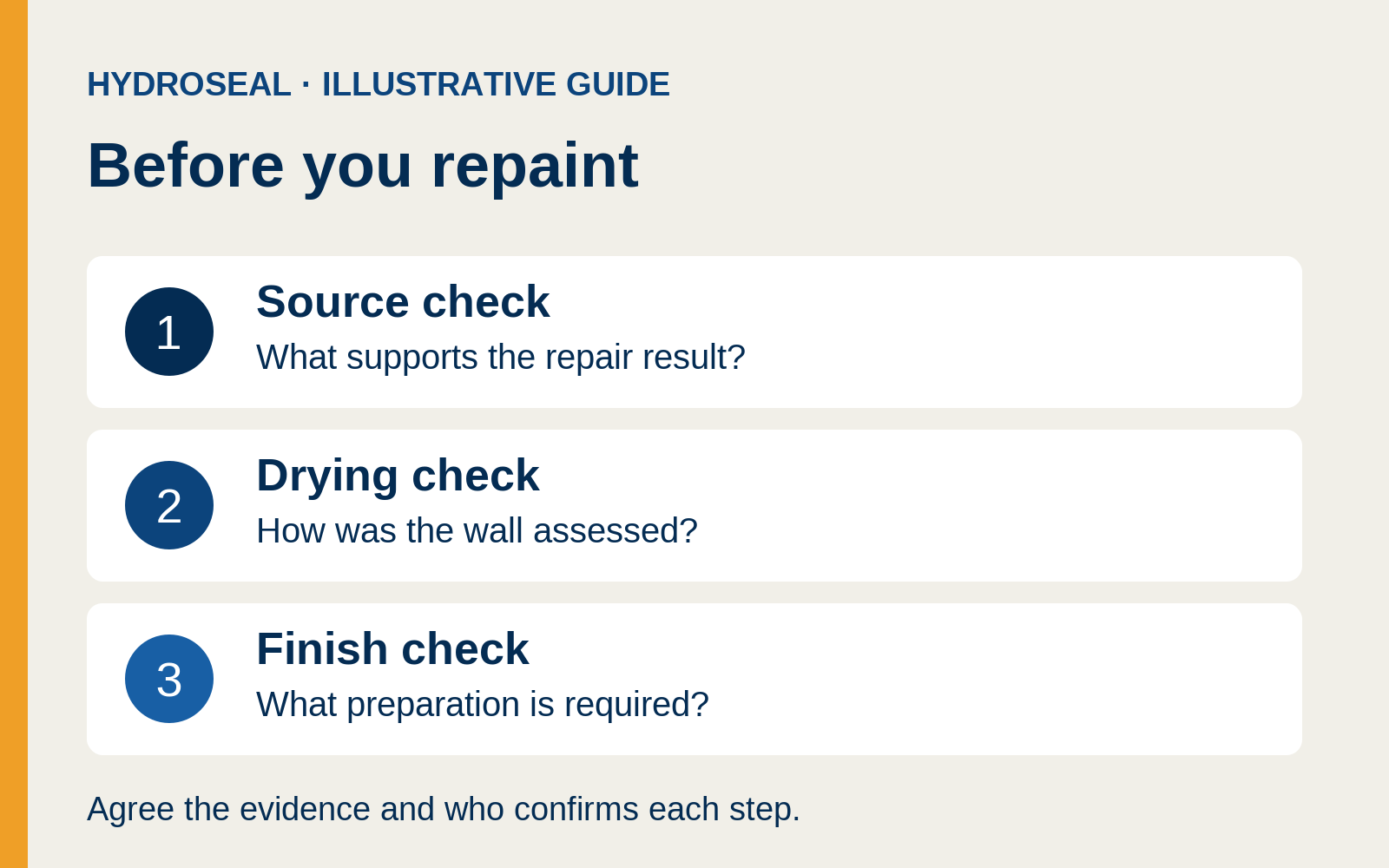
Get a free, no-obligation site inspection
Tell us what’s going wrong and we’ll diagnose the cause, explain your options in plain language, and quote, with no pressure to proceed.
Prefer to talk? Call +65 6289 6811 · We respond within 1 business day.