
Condo Ceiling Leak in Singapore: Who Is Responsible?
A brown patch spreads across the bedroom ceiling, and the first question is rarely "how do I fix it". It is "whose problem is this". In a Singapore condominium, a ceiling leak almost always involves more than one party: you, the unit above, or the management corporation (the MCST). Working out who is responsible early saves a great deal of friction later.
Here is the short version first, then the detail, including what the law actually says and how to resolve it without it turning into a feud with your neighbour.
The short answer
In most cases, whoever owns the part of the building where water is getting in is responsible for fixing it and bearing the cost.
- If the leak comes from a private unit (a failed bathroom membrane, a cracked floor, perished sealant), the owner of that unit is responsible.
- If it comes from common property (shared pipes, the external wall, the roof, the structure), the MCST is responsible.
- For a classic inter-floor leak, where water from an upper unit appears on your ceiling, the law starts by presuming the unit above is responsible, until that is shown otherwise.
The catch is that you usually cannot tell which of these it is just by looking at the stain. That is where most disputes begin, and where a proper diagnosis earns its keep.
Where condo ceiling leaks usually come from
A ceiling stain is the end of the journey, not the start. In a condo, the water is normally arriving from one of three places:
- The unit above you. The most common culprit is a failed waterproofing layer in the bathroom, kitchen or balcony directly overhead. Water passes through the floor screed and reappears on your ceiling.
- Your own external wall or windows. Wind-driven rain finds its way through cracked render, tired external-wall sealant or perished window seals, then tracks inward and downward.
- Common property. Shared service pipes in the ceiling void, the roof above a top-floor unit, or the building structure itself. These belong to the MCST.
Because water travels along beams and screed before it drips, the visible patch can sit a metre or more from the real entry point. Our guide on how to spot water damage covers the early signs worth catching before a small problem becomes an expensive one.
What the law says about inter-floor leaks
Inter-floor leakage in strata properties is dealt with under the Building Maintenance and Strata Management Act (the BMSMA), which the Strata Titles Board administers.
The part most owners care about is the presumption. Where water leaks from the ceiling of a lower unit, the law presumes the leak originates from the lot immediately above, and the upper owner (or the MCST, where it concerns common property) is treated as responsible unless they can show the cause lies elsewhere. In plain terms, the burden sits with the upstairs party to prove it is not them, rather than with you to prove that it is.
That presumption is a starting point, not the final word. If the upper owner can demonstrate the water is actually coming from a common pipe or the facade, responsibility shifts to match. This is exactly why an independent diagnosis is so useful: it replaces a guessing game with evidence.
One caveat: this is general guidance, not legal advice. Your MCST by-laws can add detail, and the Strata Titles Board is the body that decides contested cases.
When it is the MCST's responsibility
The MCST looks after common property, so the leak is theirs to investigate and repair when the source is:
- shared service or rainwater pipes running through ceiling voids
- the external facade and common walls
- the roof above a top-floor unit
- spalling concrete or the structural slab itself
If your ceiling leak traces back to any of these, raise it with your managing agent in writing and ask them to act. For facade and external-wall sources, external-wall seepage repair by rope access lets the work happen from outside, without scaffolding the whole block.
How to find out who is actually responsible
Responsibility follows the source, so finding the source is the whole game. A sensible order of events looks like this:
- Tell your neighbour and the managing agent early, and in writing. A calm, prompt message keeps things cooperative and creates a record.
- Arrange a joint investigation. For inter-floor leaks, the upper and lower owners are expected to investigate together and share access. A specialist can carry out leak detection, moisture mapping and, where needed, a close-up rope-access survey of the facade to pinpoint the entry point.
- Get the cause in writing. A short report that states where the water is entering, and why, is what settles most disputes and supports any claim.
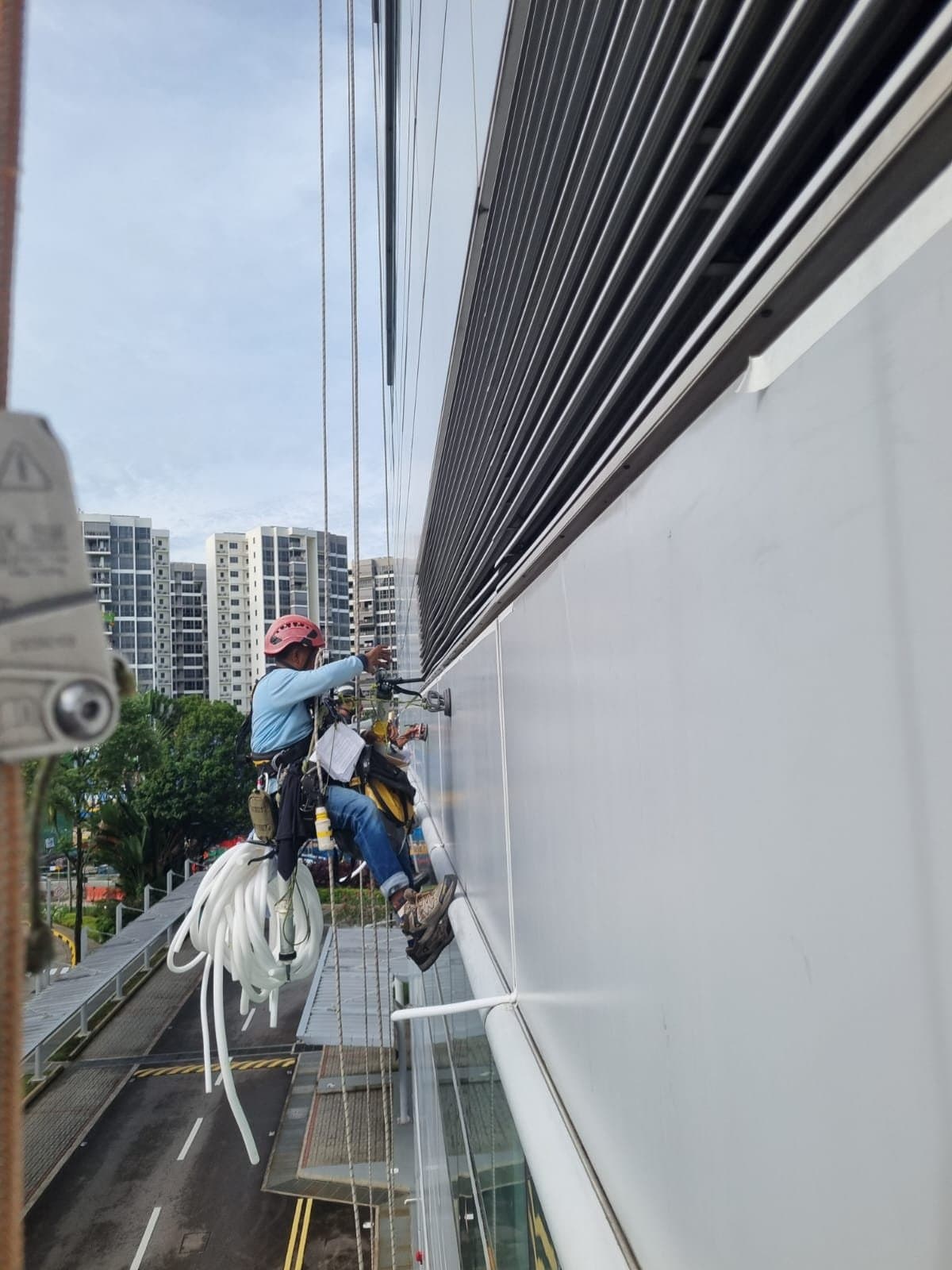
 Four Hydroseal IRATA rope-access technicians carrying out facade leak-repair works on a Singapore residential tower against a clear sky
How to resolve it without a fight
Most condo leaks are sorted out neighbour to neighbour once the cause is clear. If goodwill runs short, you have options that stop well short of court:
- The managing agent and MCST council, who can apply the by-laws.
- The Community Mediation Centre, for a low-cost, neutral conversation.
- The Strata Titles Board, which can hear the matter and make a binding order on inter-floor leakage.
In nearly every case, the sooner you establish the source, the cheaper and friendlier the outcome. Arguments drag on when nobody can say for certain where the water is coming from.
Fix the cause, not just the ceiling
Whoever ends up responsible, the repair only holds if it treats the source. Painting over a stain, or patching the ceiling from below, does nothing about the water still getting in above. The lasting fix is to trace the leak to its entry point and seal it there, whether that means re-waterproofing a bathroom, resealing the external wall, or PU injection into a cracked slab. Our overview of residential waterproofing explains how this works across a home, and if the source turns out to be a bathroom above, the signs of bathroom water damage are worth knowing.
Common questions
Is the MCST responsible for my condo ceiling leak? Only when the water is coming from common property, such as a shared pipe, the external facade, the roof or the structure. If the source is inside a private unit, that unit's owner is responsible.
The leak is from the unit above. Who pays? Under the BMSMA, the upper unit is presumed responsible for an inter-floor leak unless they can show the cause lies elsewhere. If their waterproofing has failed, they generally bear the repair.
What if my neighbour will not cooperate? Put your concerns in writing to them and the managing agent, ask for a joint investigation, and if needed approach the Community Mediation Centre or the Strata Titles Board.
Getting to the bottom of it
Not sure where your leak is coming from? That is the question worth answering first, because everything else, including who pays, follows the source. Hydroseal has traced and fixed leaks in Singapore condos since 1995. We offer a free, no-obligation site inspection, a clear written diagnosis of where the water is entering, and a Certificate of Warranty on completed work. Call +65 6289 6811 or email enquiry@hydroseal.com.sg and we will help you settle it properly.
Unsure about your property’s waterproofing?
Hydroseal offers a free, no-obligation site inspection, honest advice, no pressure.
Get a free quote
Get a free, no-obligation site inspection
Tell us what’s going wrong and we’ll diagnose the cause, explain your options in plain language, and quote, with no pressure to proceed.
Prefer to talk? Call +65 6289 6811 · We respond within 1 business day.