
Why Metal Roofs Leak in Singapore
A metal roof is one of the most reliable roofs you can put on a building in Singapore. It sheds water fast, it does not rot, and a good one will run for decades. So when the ceiling below starts staining, the instinct is to assume the sheet has failed or rusted through. Almost always, it has not.
Here is the direct answer first, then where the water actually gets in, why our climate finds those points so quickly, and what a lasting repair involves.
The short answer
Metal roofs in Singapore very rarely leak through the sheet itself. They leak at the joints in the sheet: the screws, the laps and seams, the flashing, and the gutters.
Every one of those is a place where the roof stops being a continuous sheet of metal and starts relying on a fastener, a seal or an overlap to keep water out. Those components have a shorter life than the metal around them, and they are the first thing to give. That is why a twenty-year-old roof can look perfectly sound from the ground and still drip steadily into the unit below every time a storm blows through.
It is good news, on the whole. A roof leaking at its details can usually be repaired in place. A roof that has genuinely corroded through across large areas is a much bigger conversation.
Where metal roofs actually leak
On the roofs we survey here, the water is nearly always coming in at one of five points.
- Screws and fasteners. On a screw-down roof, each fastener passes through the sheet with a rubber washer to seal the hole. The washer perishes under UV long before the metal does. Once it hardens or the screw backs out slightly, you have an open hole straight through the roof, multiplied by every screw on the elevation.
- Laps and seams. Where two sheets overlap, the joint depends on the lap being tight and, on many roofs, on a sealant bead inside it. Thermal movement works that joint every day until the seal splits and the lap starts drawing water in, often against the direction you would expect.
- Flashing and upstands. The junctions where the roof meets a parapet, a wall or a ridge are the fussiest details on the whole roof, and the most commonly rushed. Lifted, short or poorly sealed flashing is one of the leaks we see most.
- Gutters and box gutters. A blocked or ponding gutter holds standing water against a joint that was only ever designed to shed it quickly. Given time, that water finds a way over or through the upstand.
- Penetrations. Every pipe, vent, aircon support and solar bracket is a hole someone cut in a working roof. Each one lives or dies on how well it was detailed and sealed.
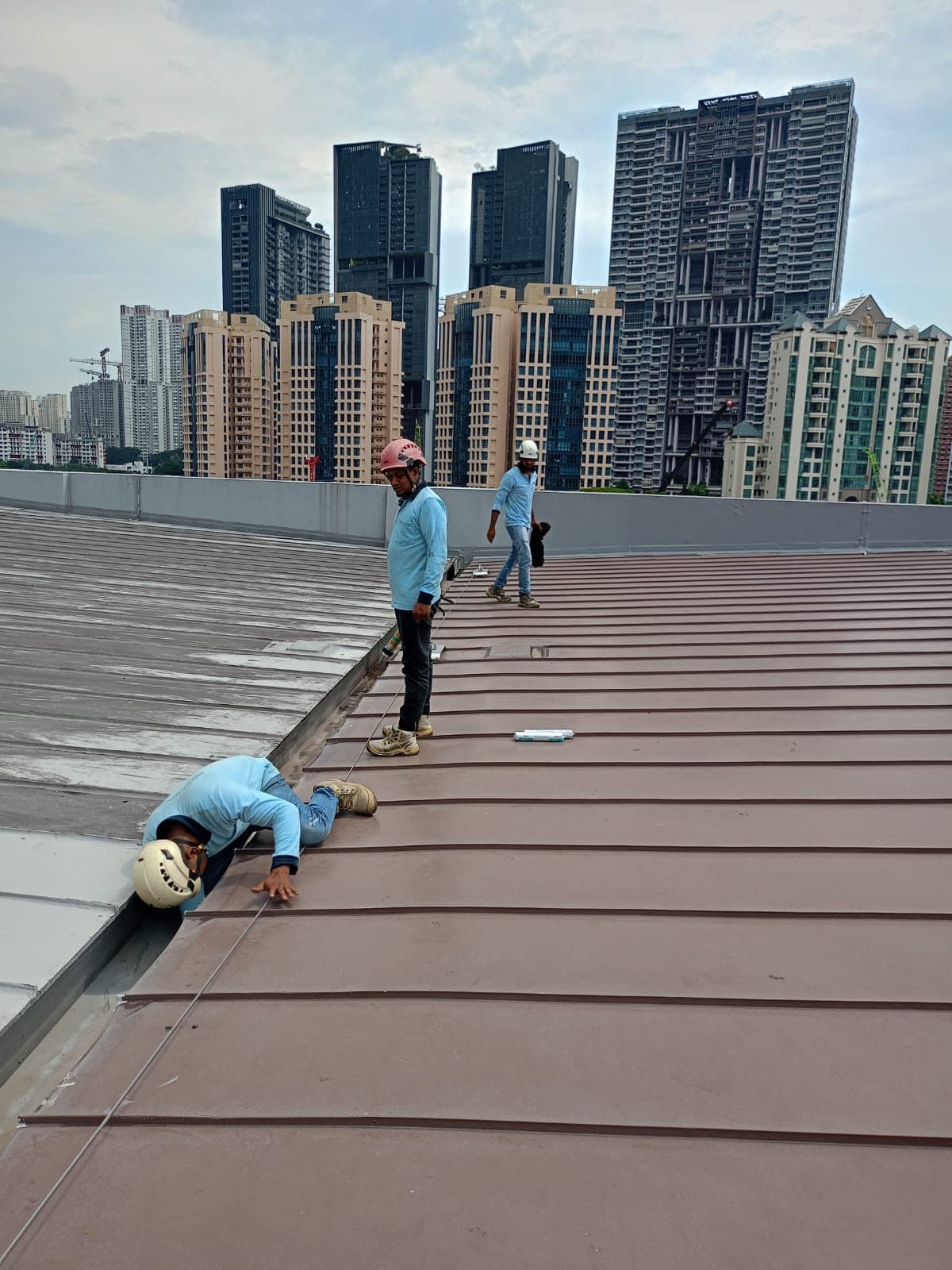
Hydroseal technicians resealing the seam and edge joints of a large metal roof in Singapore, where wind-driven rain most often finds its way in
Why Singapore's climate finds these points so fast
None of the above is a defect in metal roofing. It is our environment working on the roof's weakest components, and it does so harder here than in most places.
The sun is the main culprit. A metal roof in full equatorial sun gets genuinely hot, and it expands as it does. When an afternoon storm arrives, the temperature drops sharply and the sheet contracts again. That cycle happens most days of the year, and every cycle works the fasteners loose a fraction and stretches the sealant in the laps. Add strong UV, which hardens rubber washers and cheaper sealants until they crack, and the seals age far faster than the metal they sit in.
Then the monsoon tests the result. Heavy rain driven sideways at pressure does not politely run down the roof. It is pushed uphill into laps, under flashing and back through any hole a washer no longer covers. A joint that copes fine with vertical rain can leak freely in a squall. This is the same reason façade sealant in Singapore tends to reach the end of its life sooner here than the data sheet suggests.
Near the coast and on industrial sites, salt and airborne pollutants add corrosion to the picture, usually starting at cut edges, scratches and around fasteners rather than in the middle of a clean sheet.
The stain inside is not under the hole
This is the single most useful thing to know before you go looking for a metal roof leak, and it catches out a lot of people.
Water that gets through a roof lands on the underside of the sheet or on the purlins, and then it travels. It runs along a purlin, tracks down a rafter, and drops through the ceiling wherever it happens to find a gap. That point can be metres away from where it came in, and often on a different part of the building entirely. We have traced plenty of leaks that were entering at a ridge flashing and appearing above an office two bays away.
The practical consequence is that patching the ceiling directly above the stain, or resealing the nearest visible screw, usually achieves nothing. The drip stops for a while because the weather changed, then it returns with the next storm from the right direction. If the same stain keeps coming back after repairs, that is a strong sign the actual entry point was never found. Our guide on how to spot water damage in your home covers the wider version of this problem.
Finding the real source means getting on the roof and inspecting the details properly, ideally in the condition that causes the leak.
Recoat, repair or replace?
Once you know where the water is coming in, the question is how far to go. In practice it falls into three bands.
Targeted repair suits a roof in sound condition with a handful of failed details. We re-seal the specific laps, replace the failed fasteners with the correct oversized screws and new washers, and re-detail the flashing that is letting go. This is the right answer more often than owners expect.
Recoating suits a roof where the sheet is still structurally sound but the seals are tired across the board and surface corrosion is starting. The roof is cleaned and prepared, fasteners and seams are treated, and a liquid-applied coating system goes over the whole area, restoring a continuous waterproof skin and reflecting some heat back off the building at the same time. This buys a sound metal roof many more years for a fraction of the cost and disruption of a replacement.
Replacement is for a roof that has genuinely corroded through over large areas, or where the sheet profile itself has failed. It is the most expensive and the most disruptive, and it is a smaller share of the work than most people assume.
For an industrial or warehouse building, the deciding factor is usually not the roof at all, it is what is underneath it. Stock, machinery and production time are worth far more than the repair, which is why phased, fast-curing work over a live facility tends to win over a shutdown. That balance is the heart of our industrial waterproofing work.
How a metal roof leak is properly repaired
A repair that lasts follows the same order every time, and skipping the early steps is why so many roofs leak again within a season.
We survey the roof first and trace the entry point rather than the stain, checking fasteners, laps, flashing, gutters and penetrations across the affected area. We prepare the surfaces, because sealant and coatings only bond to clean, sound metal, and a bead gunned over dirt or an old failed seal will lift within months. Then we treat the actual defects: new fasteners and washers where they have perished, seams cut out and re-sealed with the correct weather-grade product, flashing re-detailed, and coating applied where the roof needs a full skin rather than spot treatment.
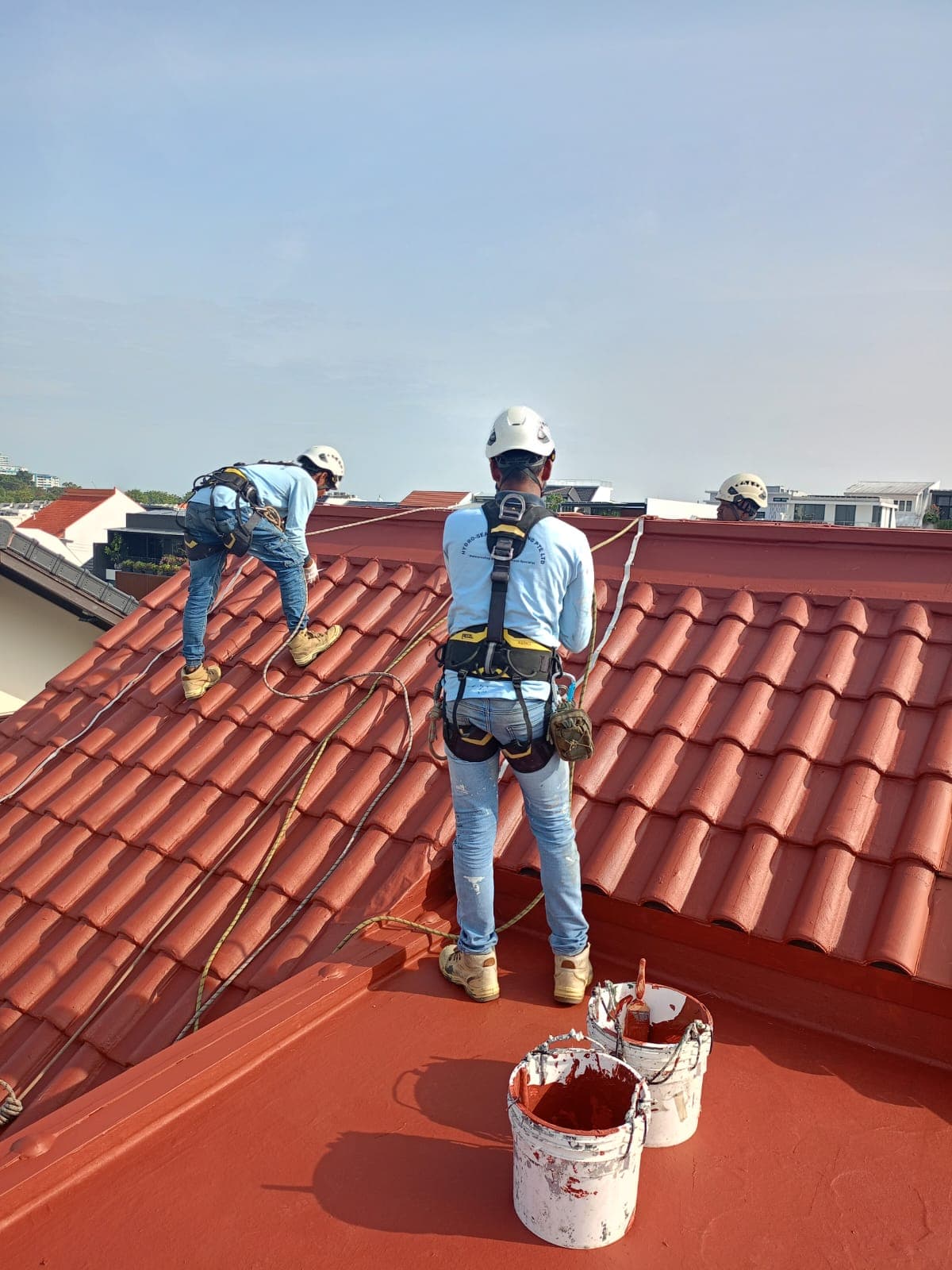
Where a roof is high, steep or awkward to stand on safely, our IRATA-certified rope-access teams reach it without scaffolding, which keeps both the cost and the disruption down. The same approach covers the rest of our roof waterproofing and repair work, and for landed homes it pairs naturally with the checks in our guide to inspecting your rooftop.
Common questions
Why does my metal roof only leak in heavy rain? Because wind-driven rain is pushed sideways and uphill into laps, flashing and worn fastener holes at pressure. A joint that sheds vertical rain perfectly well can let water straight through in a squall, which is why the leak seems to come and go with the weather.
Can a leaking metal roof be repaired without replacing it? Usually, yes. Most metal roof leaks are at the fasteners, seams and flashing rather than in the sheet, so they can be treated in place with new fasteners, resealing and re-detailing, or with a coating system if the seals are tired across the whole roof.
Why does the leak reappear after it was repaired? Most often because the entry point was never actually found. Water travels along purlins and rafters before it drops, so the stain inside can be well away from the hole outside, and resealing near the stain fixes nothing.
How long does a metal roof last in Singapore? The sheet itself can last for decades here, but the fasteners, sealed laps and flashing have a much shorter life under our sun and monsoon rain. Treating those details as maintenance items, rather than waiting for the ceiling to stain, is what gets the full life out of the roof. Our guide on making your roof last for decades goes further into this.
Does a roof coating stop leaks or just reflect heat? A properly specified liquid-applied system does both. It restores a continuous waterproof layer across the sheet, seams and fasteners, and a reflective finish also cuts the heat the roof passes into the building below.
A simple takeaway
If your metal roof is leaking, it is very likely leaking at its details and not through its sheet, and it very likely can be repaired in place. The two things that matter most are finding the real entry point rather than the nearest stain, and preparing the surface properly before anything is sealed or coated. Get those right and a sound metal roof will keep going for years yet.
Hydroseal has been waterproofing and repairing Singapore's roofs since 1995, across more than 1,000 projects with our 40-plus specialists, and every completed job is backed by a Certificate of Warranty. If you have a stain you cannot trace or a roof you are trying to decide about, we are happy to look at it first at no cost. Call us on +65 6289 6811 or email enquiry@hydroseal.com.sg to arrange a free, no-obligation site inspection.
Unsure about your property’s waterproofing?
Hydroseal offers a free, no-obligation site inspection, honest advice, no pressure.
Get a free quote
Get a free, no-obligation site inspection
Tell us what’s going wrong and we’ll diagnose the cause, explain your options in plain language, and quote, with no pressure to proceed.
Prefer to talk? Call +65 6289 6811 · We respond within 1 business day.