
Why Flat Roofs Leak in Singapore
A damp patch appears on the top-floor ceiling after a heavy afternoon. It dries out, so nobody worries. A few months later it is back, slightly bigger, and now there is a fine crack in the plaster running away from it. This is how most flat roof leaks in Singapore announce themselves, quietly and long after the water first got in.
Here is the direct answer first, then where the water actually enters, why ponding matters so much in our climate, and what a repair that lasts involves.
The short answer
Flat roofs in Singapore leak because water sits on them. A pitched roof sheds rain in seconds. A flat roof holds it, and every hour that water stays on the surface is an hour it spends looking for a way through the waterproofing layer.
That waterproofing layer is the entire defence. Unlike a tiled or metal roof, there is no second line beneath it. So when the membrane ages, when the fall that moves water to the outlets is lost, or when an outlet blocks, the roof does not leak a little. It leaks properly.
The good news is that a flat roof is usually repairable in place. In most of the cases we survey, the concrete slab beneath is sound and only the waterproofing and the drainage on top of it need attention.
Where flat roofs actually leak
On the concrete roofs and rooftop decks we inspect around Singapore, the water is nearly always getting in at one of five points.
- Ponding water. A flat roof is never truly flat. It is laid with a shallow fall so rain runs to the outlets. Over the years that fall is lost to screed shrinkage, slab deflection, patch repairs and added services, and water starts standing in the low spots instead of draining away.
- An aged membrane or coating. Torch-on membranes, liquid systems and cementitious coatings all have a service life. They go brittle, they blister, they lift at the laps, and eventually water finds the gap rather than the surface.
- Cracks and construction joints. Concrete moves, and it cracks where it is restrained. Construction joints, day joints and the junction between two pours are the natural weak lines, and they open slowly as the building settles and the roof heats and cools.
- Roof outlets and gutters. A blocked outlet turns a well designed roof into a shallow pool overnight. Leaves, silt, plastic and the general grit of a tropical city collect at the grating, and the water level simply rises until it clears the upstand or finds a joint.
- Upstands, parapets and penetrations. Every point where the roof stops being a flat plane is a detail somebody had to get right. Parapet upstands, door thresholds onto a roof terrace, aircon plinths, pipe sleeves and lightning conductor fixings are all common entry points.
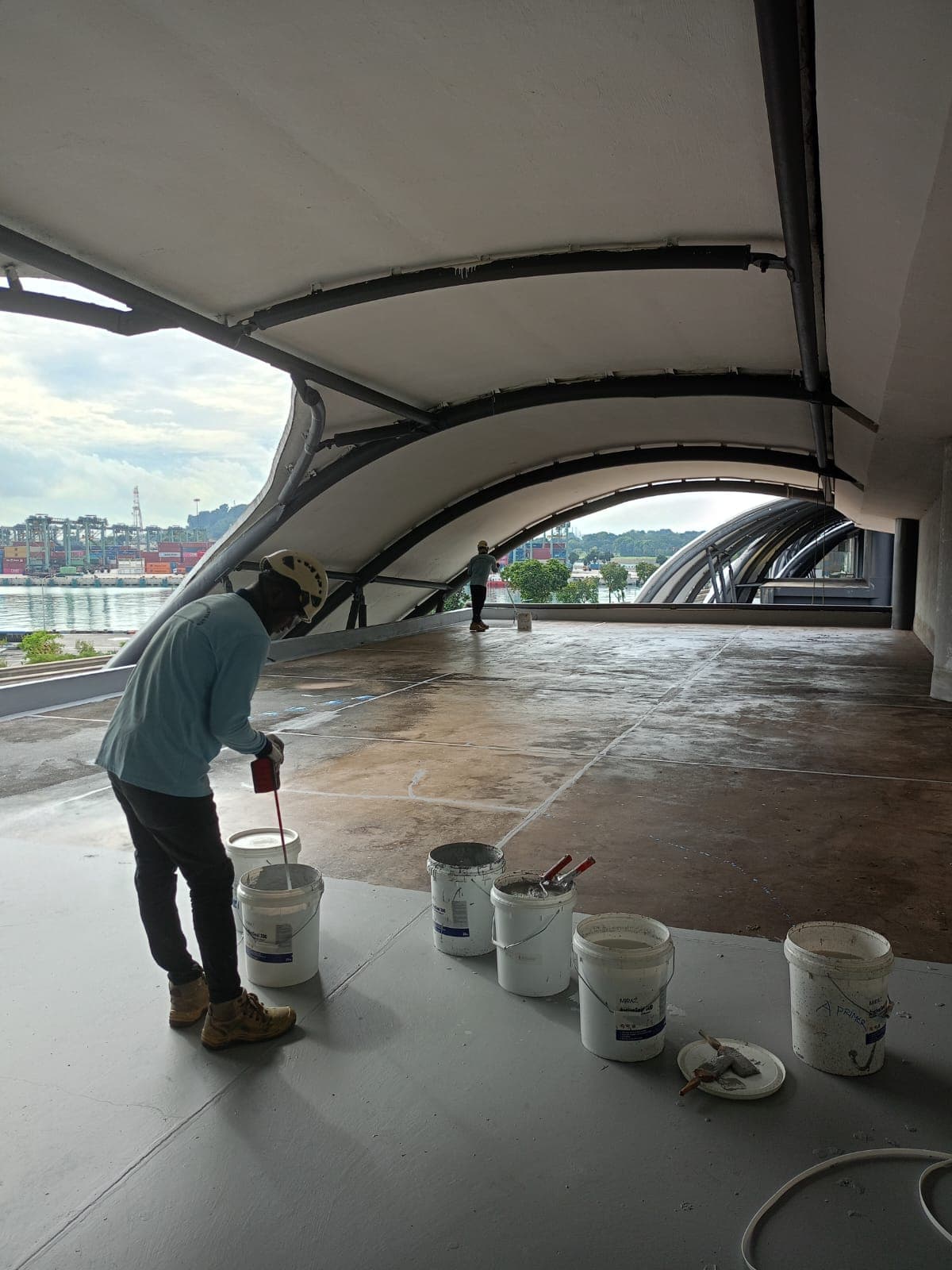
Hydroseal technicians applying a liquid waterproofing system to a large flat concrete roof deck at a waterfront commercial building in Singapore
Why ponding water matters so much here
Of everything on that list, ponding is the one owners most often dismiss, and the one that does the most damage.
A useful rule of thumb is that a flat roof should be clear of standing water within a day or two of the rain stopping. Water still sitting there after that is ponding, and it is worth taking seriously.
Standing water attacks a roof in several ways at once. It puts constant pressure on the waterproofing rather than the brief contact the layer was designed for, so any pinhole or unbonded lap becomes a slow, permanent path inward. It holds dirt and biological growth against the surface, which keeps the area damp and speeds up the breakdown of the coating. It adds weight, sometimes a great deal of it across a large roof. And in our sun, a shallow pool heats up through the day and cools sharply in a storm, which works the membrane harder than the dry areas around it.
This is why a flat roof so often fails in patches rather than all over. The low spots go first, and they go years before the rest.
What Singapore's climate does to a flat roof
Our conditions are close to the worst case for this kind of roof, and it helps to understand why.
The rain arrives in volume rather than steadily. A squall can drop more water in twenty minutes than a drainage system that is half blocked can clear in an hour, so the roof briefly becomes a tank and every detail is tested at once. Then the sun comes out. Surface temperatures on an exposed dark roof climb hard through the afternoon and fall away sharply in the next downpour, and that cycle repeats most days of the year. Membranes and sealants expand, contract and gradually lose their flexibility.
Strong UV does the rest, hardening the surface of coatings and bituminous sheets until they craze. Constant humidity means anything that gets damp stays damp, and algae and moss establish quickly in ponded areas, holding yet more moisture against the roof. It is the same set of forces that shortens the life of façade sealant in Singapore, applied to a horizontal surface that cannot drain itself.
The stain inside is not under the hole
This catches out almost everyone, and it is worth knowing before you start looking.
Water that gets through a flat roof does not drop straight down. It travels between the waterproofing layer and the slab, runs along the top of the concrete until it meets a crack, a service penetration or a construction joint, and only then comes through. The stain on the ceiling can be several metres from the actual breach, and on a roof with a screed layer the water can move further still.
The practical consequence is that patching the ceiling, or sealing the roof directly above the stain, usually achieves nothing. The drip stops while the weather is dry, then returns with the next real storm. If a leak keeps coming back after repairs, the entry point was almost certainly never found. Our guide on how to spot water damage in your home covers the wider version of this problem.
There is a second reason to trace it properly rather than live with it. Water sitting against reinforced concrete eventually reaches the steel inside, and once that starts to rust it expands and pushes the concrete cover off. That is spalling concrete, and it turns a waterproofing job into a structural repair.
Recoat, re-membrane or correct the falls?
Once the entry point is known, the question is how far the work needs to go. In practice it falls into three bands.
Targeted repair suits a roof in generally sound condition with a small number of clear defects: a cracked upstand, a failed detail around a pipe, a split at one lap. We treat those specific points and leave the rest alone. This is the right answer more often than people expect, particularly on newer roofs.
Recoating or re-membraning suits a roof where the waterproofing has reached the end of its life across the board. The surface is cleaned and prepared, cracks and joints are treated, upstands and outlets are re-detailed, and a new system goes over the whole area. Whether that is a liquid-applied system, a torch-on membrane or a cementitious coating depends on the substrate, the traffic and the exposure, which we cover in our comparison of sheet and liquid waterproofing membranes.
Correcting the falls is the extra step a roof needs when ponding is the underlying problem. Re-screeding to restore the gradient, or forming new falls to the outlets, costs more than simply re-coating. It is also the only thing that stops the same low spot failing again in a few years. Coating over a roof that ponds badly, without addressing why it ponds, is the most common false economy we see in this work.
How a flat roof leak is properly repaired
A repair that holds follows the same order every time.
We survey the roof first and trace the water to its entry point rather than working back from the stain, checking the falls, the outlets, the membrane condition, the upstands and every penetration. We look at the roof wet where we can, because a defect that is obvious during a downpour can be invisible on a dry morning.
Then the surface is prepared. Coatings and membranes only bond to clean, sound, dry substrate, and a system applied over dirt, algae or a failed previous layer will lift within a season no matter how good the product is. Cracks and joints are cut out and treated, outlets are cleared and re-detailed, and upstands are dressed properly rather than simply painted over.
Only then does the new waterproofing go on, taken up the upstands and around every penetration so the roof is a continuous surface again. Where the roof is difficult or unsafe to reach, our IRATA-certified rope-access teams get to it without scaffolding, which keeps both cost and disruption down. This is the core of our roof waterproofing and repair work, and for a landed home it pairs naturally with the checks in our guide to inspecting your rooftop.
Common questions
How do I know if my flat roof is ponding? Go up a day or two after heavy rain and look for standing water, or for the tide marks and dirt rings it leaves behind. Patches of algae, moss or discoloured coating in the same spot every time are a reliable sign that water sits there long after the rest of the roof has dried.
Can a leaking flat roof be repaired, or does it need replacing? Most can be repaired. The concrete slab is usually sound and it is the waterproofing layer and the drainage on top of it that have failed. Full replacement is far less common than owners assume, though a roof that ponds badly may need its falls corrected as part of the work.
How long does flat roof waterproofing last in Singapore? It depends on the system, the exposure and how well the roof drains. What shortens it most reliably is standing water, so two identical roofs can have very different lifespans if one holds water in the low spots and the other clears properly to its outlets. Our guide on making your roof last for decades goes further into this.
Why does my flat roof only leak in very heavy rain? Because moderate rain drains away before the water level reaches the defect. In a squall the outlets cannot clear the volume fast enough, the water rises past an upstand or a lap that is no longer sound, and the roof leaks until the level drops again.
Do I need to clear the roof outlets myself? Keeping outlets and gratings clear is the single most valuable piece of flat roof maintenance, and it costs almost nothing. A blocked outlet can put a roof under water within one storm, so a quick check before and during the monsoon months is well worth the trip upstairs.
Is a flat roof leak the same problem as a metal roof leak? No. A metal roof leaks at its joints, screws and flashing rather than through the sheet, which is a different set of defects and repairs. We cover those separately in why metal roofs leak in Singapore.
A simple takeaway
If your flat roof is leaking, start with where the water goes rather than where the stain is. Check whether it drains, check whether the outlets are clear, and check the upstands and penetrations before assuming the whole roof has failed. A flat roof that sheds water properly and has its details maintained will run for many years. One that quietly holds a pool in the corner will not, however good the membrane was on the day it went down.
Hydroseal has been waterproofing and repairing Singapore's roofs since 1995, across more than 1,000 projects with our 40-plus specialists, and every completed job is backed by a Certificate of Warranty. If you have a ceiling stain you cannot trace or a roof you are unsure about, we are happy to take a look first at no cost. Call us on +65 6289 6811 or email enquiry@hydroseal.com.sg to arrange a free, no-obligation site inspection.
Unsure about your property’s waterproofing?
Hydroseal offers a free, no-obligation site inspection, honest advice, no pressure.
Get a free quote
Get a free, no-obligation site inspection
Tell us what’s going wrong and we’ll diagnose the cause, explain your options in plain language, and quote, with no pressure to proceed.
Prefer to talk? Call +65 6289 6811 · We respond within 1 business day.