
Why High-Rise Façades Leak in Singapore
A wall of glass and cladding on the outside of a tower looks solid, so a leak twenty floors up feels like it should not be possible. Yet after a heavy monsoon downpour, water appears on an internal wall, along a window edge, or on the ceiling of the unit below, and nobody can see where it came from. If you manage or live in a high-rise building in Singapore, this is one of the most common and most frustrating problems there is.
Here is the direct answer first, then the detail behind it, so you can work out what is likely happening on your building before you call anyone.
The short answer
Most high-rise façade leaks in Singapore come from the joints and seals, not the glass or concrete panels themselves. Aged, cracked or missing sealant around cladding joints and window perimeters is the usual culprit, because that thin bead of weather-seal is all that stands between wind-driven rain and the inside of the wall.
Water gets in at these weak points, travels along the structure, and shows up somewhere unexpected inside. The fix is to trace the entry point, renew the failed seals, and repair any cracked render or concrete around them. On a tall building, that work is reached most efficiently by rope access rather than scaffolding or a gondola.
Where high-rise façades actually leak
A façade is a system of panels held together by joints, and water finds the weakest joint. These are the entry points we trace most often on Singapore towers.
Failed sealant joints between panels
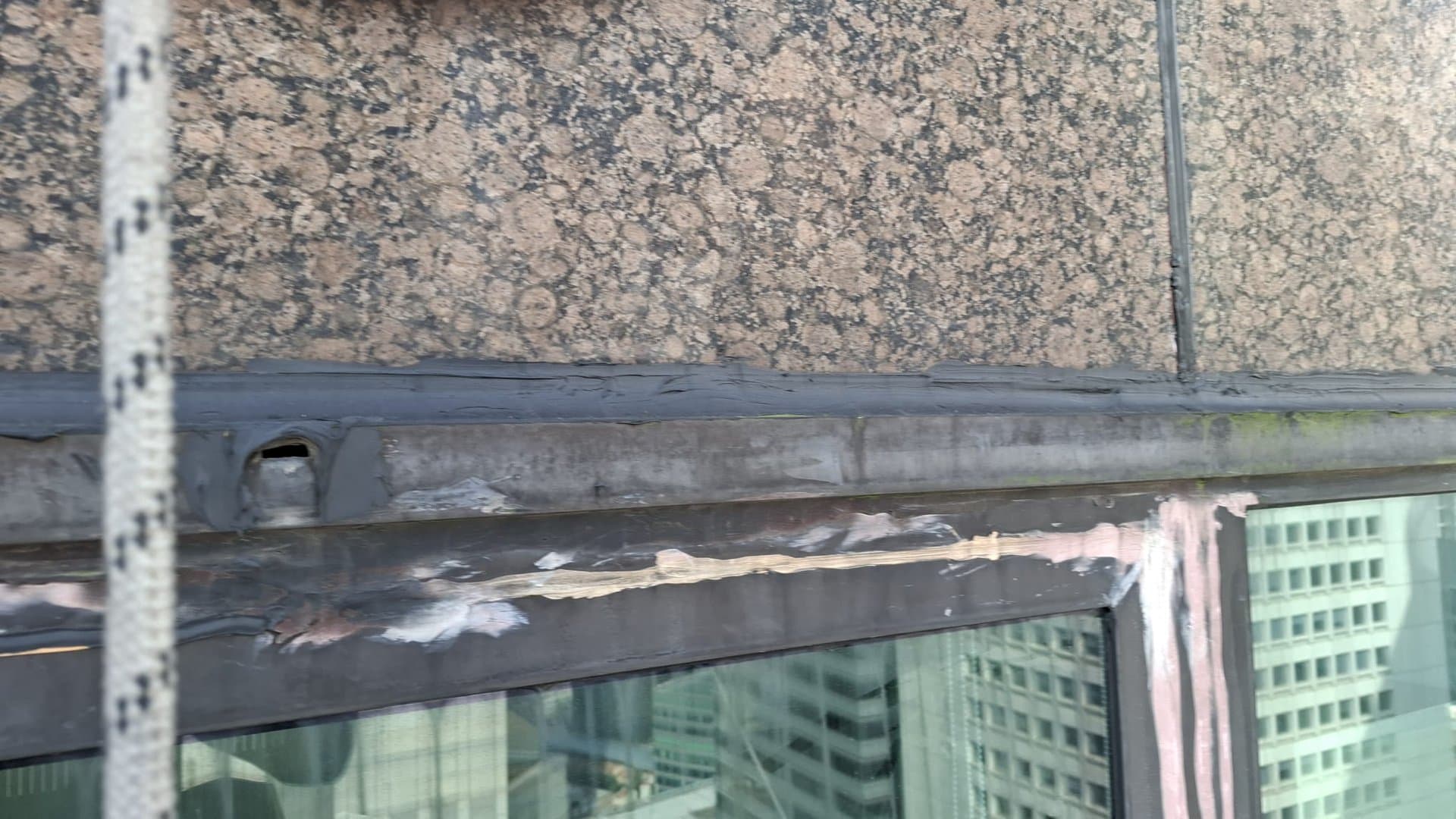
Curtain walls, granite or stone cladding, and precast panels are separated by movement joints filled with a flexible sealant. That sealant takes the full force of the sun and rain every day, and over the years it hardens, cracks, shrinks back or peels away from the edge of the joint. Once it opens up, wind-driven rain is pushed straight through. This is the single most common source of high-rise leaks we see, which is why façade sealant replacement is often the core of the repair.
Window and curtain-wall perimeter seals
The gap around every window and glazed panel is sealed against the frame. On a glass curtain wall in particular, water often enters at the perimeter of a pane or where the frame meets the structure, then runs down inside the wall cavity. If your leak appears along a window edge, especially during heavy, gusty rain, worn window frame sealing is a likely cause.
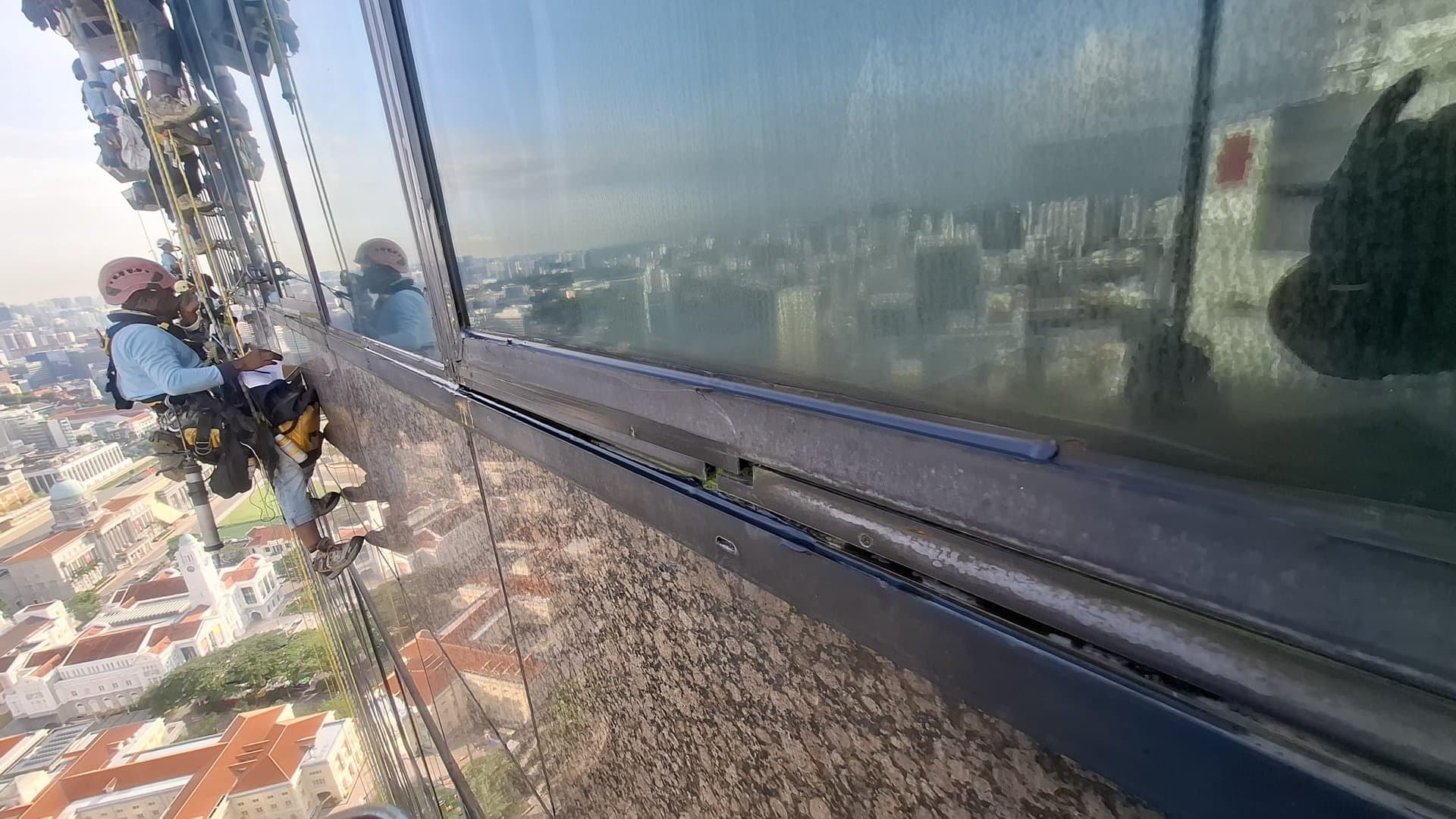
Hydroseal IRATA rope-access technicians renewing a sealant joint on a high-rise glass façade in Singapore's CBD to stop water leaking in
Cracks in render, plaster or concrete
Rendered and painted walls develop hairline cracks as the building moves and the surface ages. Each crack is a path for water, and a crack that reaches the reinforcement inside can also start the rusting process behind spalling concrete. On these walls the leak often shows as a damp patch that spreads, and the fix pairs crack repair with a fresh protective coating.
Blocked or missing weep holes and flashing
Many façade systems are designed to let a small amount of water in and then drain it back out through weep holes, with flashing to guide it. When those drainage paths are blocked with dirt or were never detailed properly, water backs up and finds its way inward instead. This one is easy to miss without an on-site survey.
Why Singapore's climate makes it worse
Every one of those weak points ages faster here than it would in a cooler, drier place. Our sealant, seals and coatings live under intense equatorial sun, so ultraviolet exposure and constant heat break them down years earlier than the numbers on a data sheet suggest.
Then there is the rain. Monsoon downpours arrive with real wind behind them, and wind-driven rain does not fall neatly downward, it is pushed sideways and upward against the wall and forced into any open joint. The daily heat-and-cool cycle also expands and contracts the panels, working every joint a little wider over time. A high-rise façade in Singapore simply gets tested harder, and more often, than most.
How the leak is traced
The hardest part of a façade leak is rarely the repair, it is finding where the water actually enters. Water can travel a long way inside a wall before it appears, so the damp patch you see is often nowhere near the real opening.
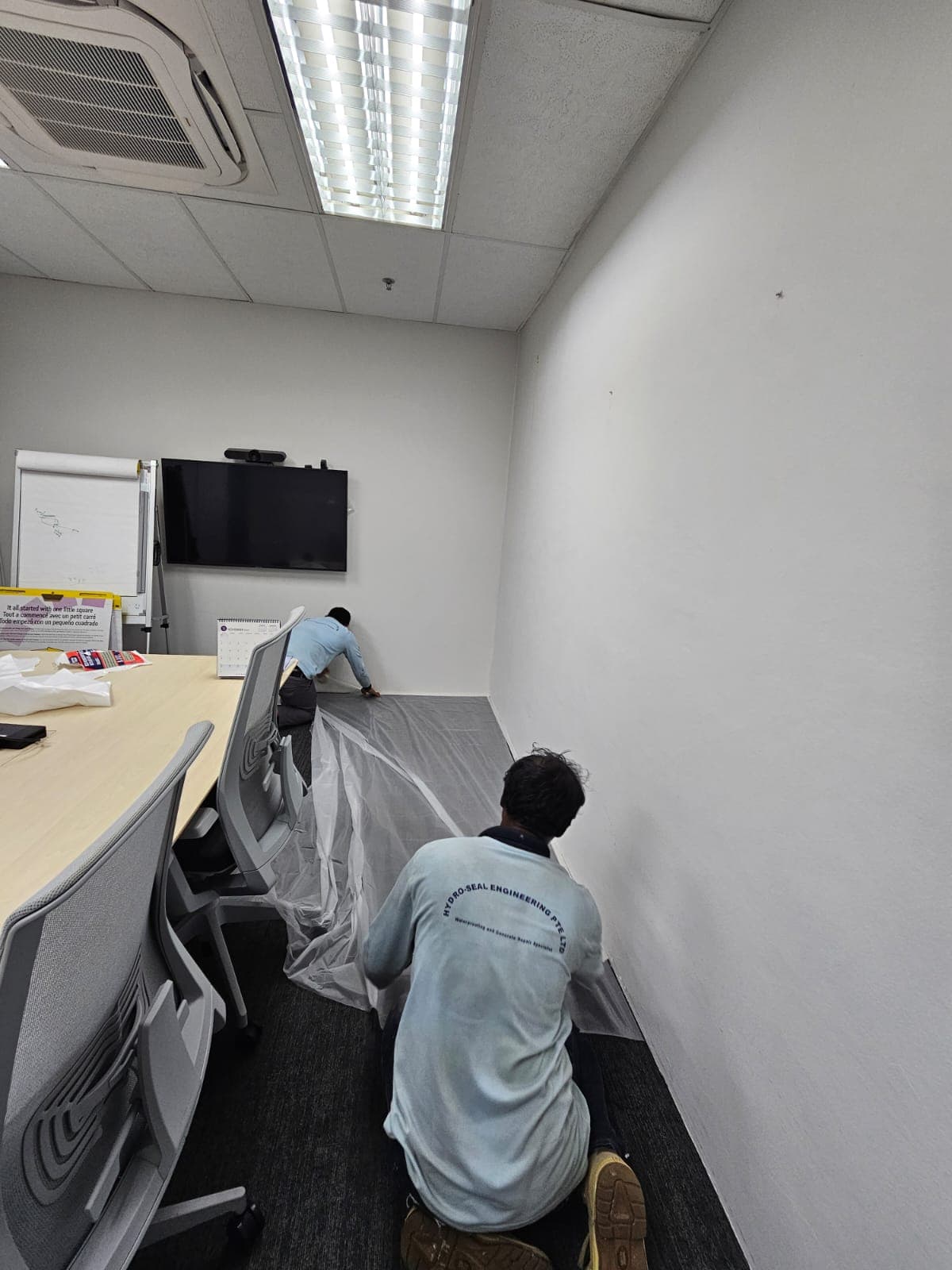
On site, we start from the internal symptom and work outward: mapping where the water shows, checking it against the elevation, and inspecting the suspect joints, window perimeters and cracks at close range from the rope. Where the source is not obvious, controlled water testing on the façade helps confirm the exact entry point before anything is sealed. Getting this right matters, because sealing the wrong joint leaves the leak live and wastes everyone's time. If you are still confirming the symptom inside, our guide on how to spot water damage in your home can help you describe it clearly before the survey.
How each cause is fixed
Once the entry point is confirmed, the repair follows the fault:
- Failed sealant joints are cut out fully, the joint is cleaned and primed, and the correct grade of sealant is re-gunned to a proper profile. Details are in our façade sealant replacement service.
- Window and curtain-wall perimeters are stripped of old, hardened sealant and resealed against the frame, part of our window frame sealing work.
- Cracked render and concrete are opened up, repaired and recoated, and where seepage runs through the wall body we treat it as external wall seepage repair.
- Blocked drainage is cleared and, where needed, the flashing and weep detailing are corrected so the system drains as intended.
For a building due its statutory checks, this work often dovetails with a periodic façade inspection under BCA requirements, where defects are logged and rectified as part of keeping the building envelope safe.
Why patching over the paint never lasts
It is tempting to skim over a damp patch with filler and paint from the inside, and it looks solved for a week. But the water is still entering from outside, so the patch soon stains, blisters and fails again. A lasting repair has to close the entry point on the external face of the wall. That is the difference between hiding a leak and stopping it.
Reaching the work: rope access on a tall building
Once the repair is clear, the question is how to reach it safely and without disrupting the building. On a high-rise, IRATA rope access usually reaches façade joints and window perimeters faster and at lower cost than erecting scaffold or rigging a suspended cradle, and it keeps the building open while the work happens. For the few heavy or platform-based scopes where a cradle earns its place, our guide to rope access vs gondola explains when each one wins.
Preventing the next leak
Façade leaks are far cheaper to prevent than to chase. The seals are consumable by design, so they need renewing on a sensible cycle rather than only after they fail. Our explainer on how long façade sealant lasts in Singapore sets out realistic timelines and the warning signs that a reseal is due. A periodic close-up survey of the elevation catches an opening joint while it is still a quick touch-up, long before it becomes a leak inside someone's unit.
In a condominium there is one more thing worth settling early: who is responsible for the repair. External walls and the façade are usually common property under the MCST rather than the individual owner, a point we cover in who is responsible for a condo ceiling leak.
Common questions
Why does my high-rise unit only leak during heavy rain? Because most façade leaks are driven by wind, not just water. In light rain the wall sheds water normally, but a gusty monsoon downpour pushes rain sideways into open joints and worn window seals, so the leak appears only when the weather is bad enough to force water through the weak point.
Where do high-rise façades leak most often? At the joints and seals rather than the panels. Aged sealant between cladding panels and around window and curtain-wall perimeters is the usual entry point, followed by cracks in render or concrete and blocked drainage paths.
Can you find the leak if the water appears far from the wall? Usually yes. Water travels along the structure before it shows inside, so we trace it from the internal symptom back to the external source, inspecting the suspect joints at close range from the rope and using controlled water testing to confirm the exact entry point before sealing.
Is rope access safe for façade leak repair on an occupied tower? Yes. Working at height in Singapore falls under the Workplace Safety and Health Work at Height requirements whichever method is used. Hydroseal technicians are IRATA-certified and the company is bizSafe registered, so risk assessments and safety documentation are in place before the first descent, and the building stays open while we work.
Talk to us before it spreads
A façade leak only gets larger, and more expensive, the longer the water is left to travel through the wall. If you have a damp patch, a stained ceiling in the unit below, or water tracking in along a window during heavy rain, it is worth having the elevation looked at properly. Hydroseal has traced and repaired Singapore façade leaks by rope access since 1995, with more than 1,000 projects completed across the island. We offer a free, no-obligation site inspection, a clear explanation of where the water is getting in and what needs doing, and a Certificate of Warranty on completed work. Call +65 6289 6811 or email enquiry@hydroseal.com.sg and we will help you get to the bottom of it.
Unsure about your property’s waterproofing?
Hydroseal offers a free, no-obligation site inspection, honest advice, no pressure.
Get a free quote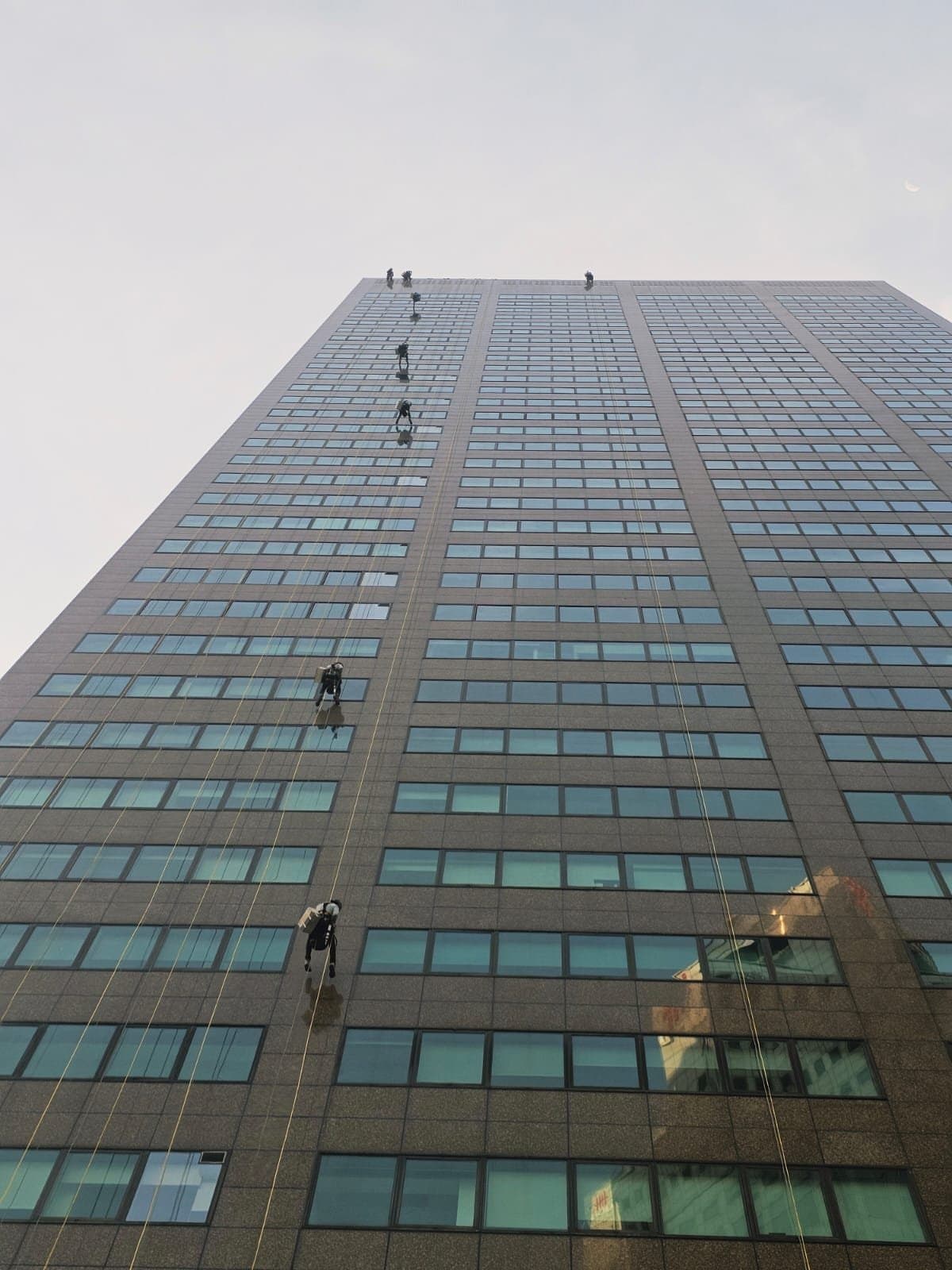
Get a free, no-obligation site inspection
Tell us what’s going wrong and we’ll diagnose the cause, explain your options in plain language, and quote, with no pressure to proceed.
Prefer to talk? Call +65 6289 6811 · We respond within 1 business day.