
Façade Sealant Repair Handover: An MCST Checklist
A façade sealant repair handover should let the MCST or managing agent answer four questions: where was work carried out, what was installed, how was it checked and what remains unresolved? A folder of finished-joint photographs is useful, but it cannot answer all four on its own.
Agree the evidence before work begins, link every record to a location and keep outstanding items visible. This guide concerns the handover of weather-seal repairs. It does not establish structural-glazing adequacy or replace a statutory façade inspection.
Agree the handover before access starts
Include the required records in the repair scope so the contractor can collect them while the joints are accessible. Some preparation details will be concealed after sealing, and obtaining missing evidence later may require another visit.
Identify who prepares the records, who reviews them and which stages require an inspection before work continues. The appropriate reviewer depends on the appointment and project requirements. An MCST council member can check whether a document is present without being the person qualified to assess its technical adequacy.
Where repairs follow a Periodic Façade Inspection, involve the appointed Competent Person in the required follow-up. BCA's PFI guidance places the inspection responsibility with that professional; access-team records support the agreed work but do not replace the appointment or reporting duties. Our PFI preparation guide explains that distinction.
Build the evidence around identifiable locations
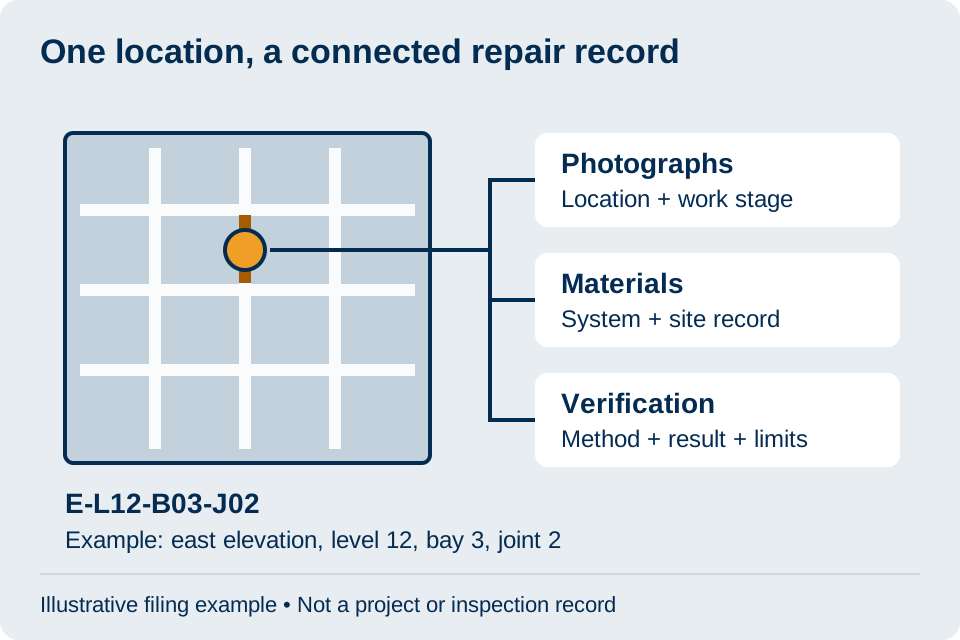
Use a marked elevation or another agreed location plan. Give each repair a reference that appears on the work schedule, photographs, inspection records and any follow-up item. Keep the naming simple enough for the next managing agent to understand.
For example, the illustrative reference E-L12-B03-J02 could mean east elevation, level 12, bay 3, joint 2. That is a proposed filing convention, not a Hydroseal project record. A wide photograph establishes the position; closer photographs show the relevant condition and work stage.
The handover should distinguish the following records:
| Record | What to check |
|---|---|
| Final scope and location plan | Completed areas, approved changes, excluded joints and inaccessible locations are identifiable. |
| Preparation and application record | Dated stage photographs and site notes show what was observed and done at each referenced area. |
| Material record | The installed product and relevant supporting materials can be linked to the work, with batch information where specified. |
| Inspection and test record | Location, date, method, result, acceptance criterion and responsible reviewer are recorded. |
| Outstanding-item register | Each unresolved item has an explanation, next action, owner and review date. |
| Maintenance and warranty documents | The covered areas, obligations, exclusions and route for reporting a problem are clear. |
Tremco's sealant-restoration documentation guidance recommends maintaining an application log with locations, conditions, material batches and observations. Use the relevant manufacturer's requirements for the specified system; a generic checklist is not a substitute for that information.
A product data sheet identifies a product's requirements. It does not, by itself, demonstrate that the product was installed at a particular joint. Similarly, an overall completion photograph may establish the finished appearance without showing the preparation beneath it. Keep those different types of evidence connected.
State what the checks actually establish
Define the proposed inspection and testing with the responsible contractor or professional before work starts. Record the method, areas covered, required conditions and acceptance criteria. The appropriate checks depend on the joint, system and purpose of the repair.
For example, Sika's weather-sealant guideline discusses documented field adhesion checks. This is a product-system reference, not a universal test instruction for MCST staff. The appointed team should determine the applicable procedure and deal with any disturbed test location.
An adhesion result and a water-ingress check answer different questions. If water testing or rainfall observation forms part of the agreed verification, record the affected locations, conditions and result. A satisfactory result at selected joints should not be described as proof that every joint on the elevation was checked.
Treat “not checked” as a separate status from “passed”. For the illustrative joint E-L12-B03-J02, a record might show application complete but the agreed verification still outstanding. Keep that item open, with a responsible person and next step, rather than allowing a final photograph to imply that every requirement has been satisfied.
Managers should not cut joints or improvise water tests to fill gaps in the records. Request the missing evidence or an appropriate follow-up from the appointed team. If leakage continues, revisit the findings and repair boundary; our façade-leak investigation guide explains why water near a joint may have another source.
Reconcile exclusions, variations and warranties
Compare the original scope with the final location plan. Check that omitted areas, changes discovered during preparation and additional work are explained. An excluded area should remain visible in the building's maintenance record even if the current contractor has finished its agreed work.
Request written warranty terms identifying the work covered, the relevant dates, exclusions, maintenance obligations and how a concern should be reported. Distinguish a manufacturer's product warranty from a contractor's workmanship or leakage undertaking where separate documents are offered. Do not assume that either covers every future leak into the building.
Review completion and any outstanding contractual steps against the actual agreement. This checklist does not decide payment entitlement or contractual liability. Where the parties disagree, preserve the evidence and obtain appropriate advice on the contract.
Keep the record usable after the contractor leaves
Store one indexed handover pack in the MCST's agreed record system. Include a key to the location references and retain the final version of the scope, alongside the related changes. Avoid leaving essential photographs only in a temporary chat or an individual's phone.
When a fresh leak report arrives, record its date and location, then compare it with the treated areas and outstanding items. That helps the investigating team distinguish a possible recurrence from a different defect. The maintenance plan should follow the actual system and condition, as discussed in our façade sealant maintenance guide.
Hydroseal can discuss a façade repair scope and the records needed for handover. Arrange a free, no-obligation site inspection and bring the defect register, previous repair plan and available findings so the proposed work can address the building's evidence.
Unsure about your property’s waterproofing?
Hydroseal offers a free, no-obligation site inspection, honest advice, no pressure.
Get a free quote
Get a free, no-obligation site inspection
Tell us what’s going wrong and we’ll diagnose the cause, explain your options in plain language, and quote, with no pressure to proceed.
Prefer to talk? Call +65 6289 6811 · We respond within 1 business day.